
KARVE Franchise · Guide
How to Evaluate a Pilates Franchise in the UK: Investment, Support and Growth
To evaluate a Pilates franchise in the UK, examine four areas: the full investment (fees, equipment, fit-out, working capital and training); the operational support on offer (site selection, design, certification, marketing and ongoing review); the growth potential of the method and format; and how transparent the franchisor is throughout the process.
Request information
One form, about a minute. We reply within 24 hours.
KARVE today
- 7KARVE studios open
- 5countries
- Corporate clubsin London and Dubai
- Partner clubsin Athens, Jeddah and Kuwait City
Drawn from the live territory roster — see every open, sold and reserved market.
01
What the investment really covers
Boutique fitness franchises can look similar on a summary sheet and vary enormously in practice. The headline franchise fee is rarely the number that matters most. Before signing anything, map out every component of the total investment.
A franchisor that does not publish its fees is not automatically a red flag. Premium brands often disclose financials only after a mutual NDA, so that commercial terms do not reach competitors. What matters is whether full disclosure follows promptly once that NDA is signed. If a franchisor cannot give you a complete cost breakdown before you commit, ask why.
In a Pilates franchise, the machines are the product. Ask whether the franchisor designs and makes its own equipment or sources it from a third party. A franchisor that supplies its own machines controls quality, availability and the member experience end to end. Ask about financing too: equipment financing over six or twelve months changes the capital you need in the first year.
| Component | What to ask |
|---|---|
| Franchise fee | What does it include: training, territory review, the licence to the method and brand? |
| Equipment | Who makes it, what does it cost, and is financing available? |
| Fit-out | Is there a design specification, and who manages the build? |
| Working capital | How much runway does the franchisor expect you to hold through ramp-up? |
| Training | Is instructor certification included, or charged separately? |
02
Support you should expect before you open
Opening a club is the easy part to imagine. Running one well for years is harder. The quality of franchisor support is what separates a franchise from an expensive licence. Good pre-opening support covers at least these areas.
- Site selection: the franchisor should review your proposed location, not just approve it. Footfall, demographics, competition and lease terms all affect viability.
- Design and fit-out: you should receive architectural drawings or a detailed specification based on your floor plan, not a generic mood board.
- Instructor recruitment and certification: the franchisor should help you find instructors and put them through a structured certification. If instructors are the product, their training cannot be an afterthought.
- Marketing before day one: a launch plan that starts before opening, not after. Pre-opening memberships, digital advertising and local events decide how quickly a club builds its member base.
03
Support you should expect after you open
Ongoing support is where many franchise relationships fall short. Ask specifically about the three things below, and ask to speak with an existing partner before signing. Their experience of post-opening support will tell you more than any brochure.
- Operations reviews: how often, who conducts them, and what happens when a club is underperforming?
- Booking technology: is there a brand app, a website and third-party integrations such as ClassPass, or will you be assembling your own stack?
- Marketing support: is there a dedicated marketing function, or are you handed a brand guide and left to find an agency?
04
Growth potential
Not all Pilates franchises offer the same ceiling. Three factors decide how much room a franchise has to grow: how distinctive its method is, the format of the club, and the pathways available for multi-unit or territory expansion.
A franchise built around a generic reformer class competes on price and convenience. A franchise built around a trademarked method, taught only by instructors certified by the brand, has a position that does not erode as the market fills up. Ask whether the method is proprietary, whether instructors are certified through the franchisor’s own programme, and whether the class format is standardised across every club.
A studio that only sells classes gives members one reason to visit. A club format that includes private sessions, retail and a café gives members more reasons to come in, which matters for the member experience and for how the club feels on quieter days.
Ask whether the franchisor offers single-club, multi-unit and master-territory agreements, or only one of these. A partner who wants to grow beyond one location needs a clear framework for doing so. Territory rights are agreed case by case. Country development rights and any exclusivity are available only through a separate development agreement, where applicable.
05
Questions to ask every franchisor
Use this list as a baseline with any Pilates or boutique fitness franchisor. A mature, well-run franchise should answer every one without hesitation.
- What is the total investment range, including equipment, fit-out and working capital?
- Do you make your own equipment, and is financing available?
- When and how is full financial disclosure provided?
- Who leads onboarding, and what does it cover?
- How are instructors certified, and who runs the training?
- What marketing support is provided before and after opening?
- What does ongoing operational review look like?
- What booking technology is included, and who manages it?
- Is the method trademarked and taught only through your certification programme?
- What does the club format include beyond classes?
- What single-club, multi-unit and territory pathways are available?
- Can I speak with an existing partner in a comparable market?
- How many clubs are open, and how many have closed?
- What is the typical timeline from first conversation to opening?
- Are partners expected to be hands-on operators, or can the club be managed remotely?
06
How KARVE answers each of these
Investment. KARVE does not publish its fees. Full financial disclosure follows a mutual NDA, as part of a structured process: intro call, NDA and financial disclosure, market and territory review, a visit to a live club, terms and agreement, then site search. A minimum of £500,000 in liquid capital is required to be considered. KARVE designs and manufactures its own Transformer machines, found only in KARVE clubs, and offers 6 and 12 month financing on them.
Support. Onboarding is led by KARVE’s managing director. Architectural drawings are produced from the partner’s own floor plan and handed to the partner’s construction team. KARVE helps recruit instructors and certifies them through its own course and exam, at an on-site academy or at the academies in London or Dubai. Front-of-house and manager training is included. TONE, KARVE’s in-house marketing agency, handles digital marketing, media buying, launch and promotional events and in-club retail marketing, starting before the club opens. The booking stack is the KARVE app, the KARVE website and ClassPass, and the club stays on operational review after opening.
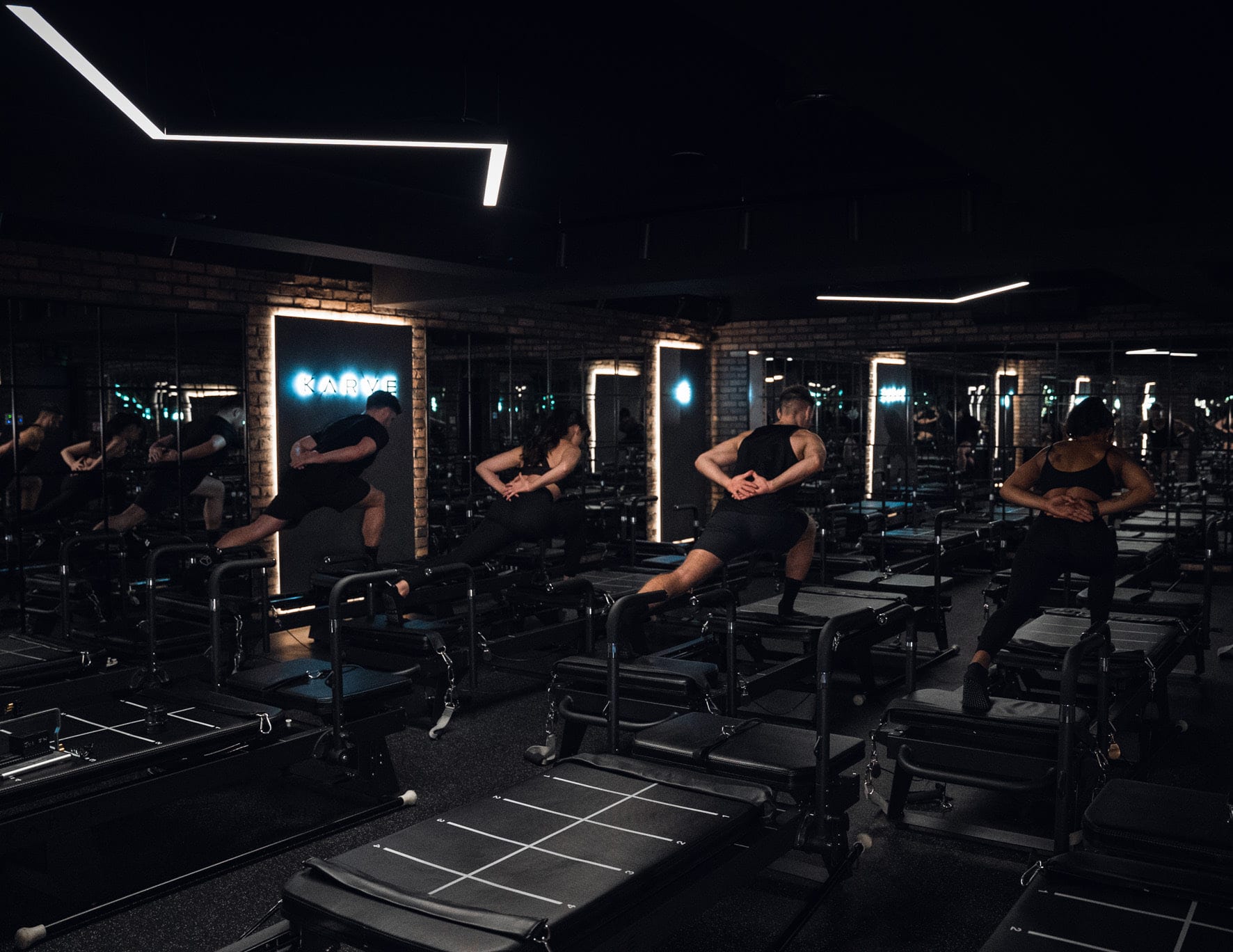
Growth. Transformer Pilates™ is KARVE’s trademarked 50-minute method: five minutes of warm-up, forty of training and five of stretch, taught only in KARVE clubs by instructors certified through KARVE’s own programme. The KARVE club format includes a café, private sessions, retail and recovery features. Single-club, multi-unit and master-territory pathways are available. Territory rights are agreed case by case. Country development rights and any exclusivity are available only through a separate development agreement, where applicable.
The network today. KARVE’s corporate-owned clubs are in Kensington, Chelsea, Victoria and Dubai, with Clapham opening in January 2027. Partner clubs operate in Athens, Jeddah and Kuwait City. Muscat opens in November 2026, Doha on 1 December 2026 and Singapore in January 2027; Riyadh is in progress.
The timeline. Three to six months from first conversation to signature, and nine to fifteen months from signature to opening, depending on market and site. Partners are operators, not passive investors.
In practice
What a partner gets
Each part of the KARVE system is there for a specific outcome at opening.
Site guidance a signed unit that fits the club format
KARVE advises on the location and the unit itself, so the search is aimed at a site that can hold the main Transformer studio and the rest of the club format.
Instructor certification a launch team that can teach the method on day one
Your instructors are trained and certified in the Transformer method before opening, so the first class is taught as a KARVE class.
TONE launch marketing local awareness before the doors open
KARVE’s in-house agency runs the launch plan and local assets ahead of opening, so the club is known in its neighbourhood before day one.
KARVE-supplied Transformers a format identical to London
The machines come from KARVE, so the class taught in your club is the same class taught in Kensington, Chelsea and Victoria.
Illustrative — not a forecast
How it comes together
Agreement
A partner is approved for a market, signs the agreement and begins onboarding led by KARVE’s managing director.
Site and build
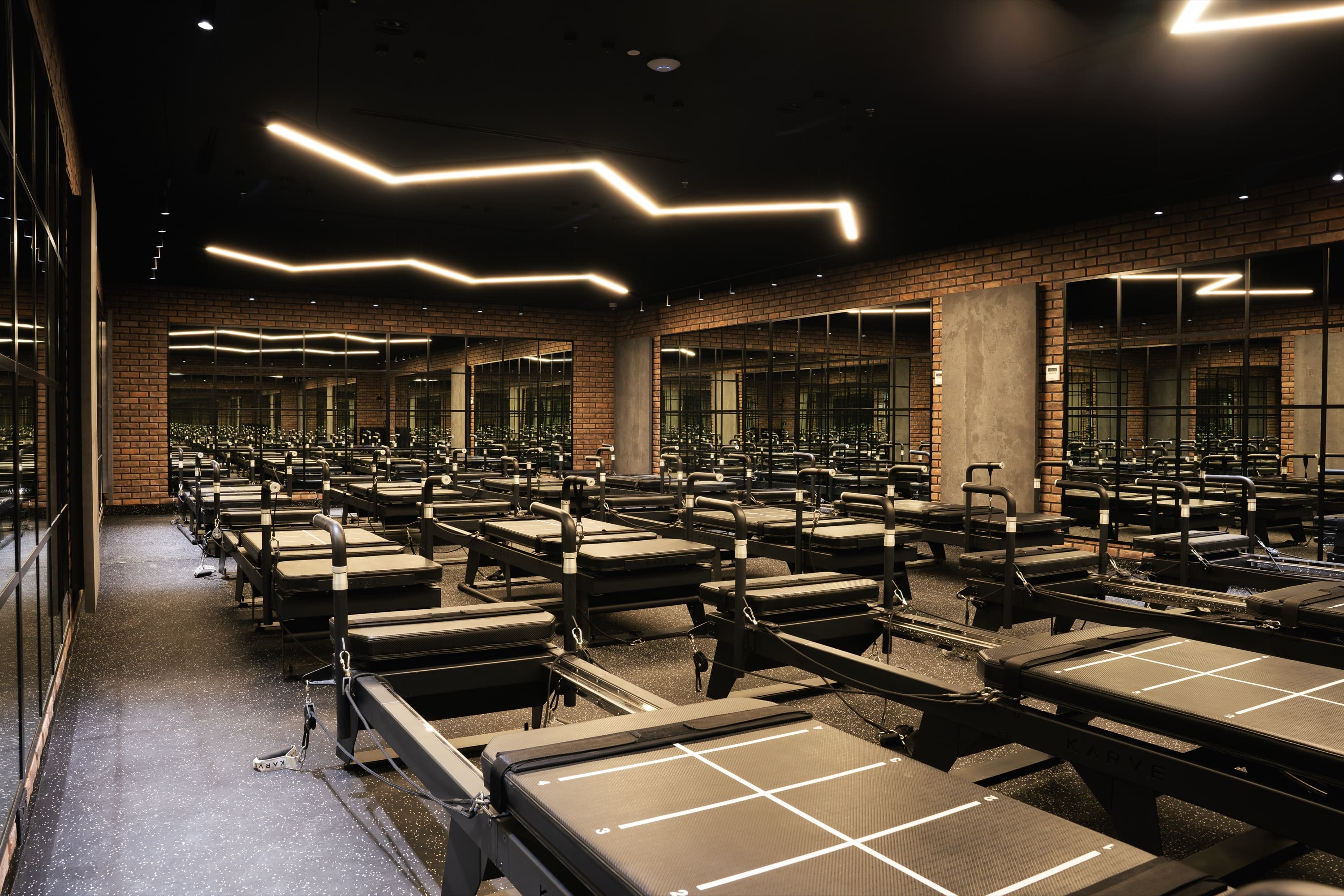
KARVE’s site guidance and architectural design system shape the unit into a KARVE club: the main Transformer studio, with the café, private sessions, retail and recovery features alongside.
Team and launch marketing
Instructors are trained and certified in the Transformer method while TONE, KARVE’s in-house agency, builds local awareness ahead of opening.
Opening day
KARVE-supplied Transformer machines are installed and the first class runs in the same format as the London clubs.
This is an illustration of the sequence, not a forecast. It carries no dates, costs or performance figures; commercial terms are shared with qualified applicants only.
Frequently asked questions
How much does it cost to open a Pilates franchise in the UK?
It varies with the brand, the city, the unit and the equipment. The components are a franchise fee, equipment, fit-out, working capital and training. Franchisors that do not publish fees usually provide the full breakdown after a mutual NDA. For KARVE, a minimum of £500,000 in liquid capital is required to be considered; full financial details are shared under NDA.
What is the difference between a Pilates franchise and an independent reformer studio?
A franchise gives you a brand, a method, an operating system and ongoing support. An independent studio gives you full control but you build everything yourself: brand, training, marketing, technology and operations. The franchise trades some autonomy for a faster, more supported path to opening.
Do I need experience in fitness or Pilates to open a franchise?
Not at KARVE. Partners are active operators rather than passive investors; operating capability, capital and commitment to the market matter more than a fitness background. Instructors are certified through KARVE’s own course and exam, and front-of-house and managers are trained as part of onboarding.
How long does it take to open a Pilates franchise?
For KARVE, three to six months from first conversation to signing, then nine to fifteen months from signing to opening, depending on market and site. Site search, fit-out and instructor certification take up most of that period.
What territory rights come with a Pilates franchise?
They differ by franchisor and by market, so ask for the exact wording. For KARVE: Territory rights are agreed case by case. Country development rights and any exclusivity are available only through a separate development agreement, where applicable.
Read next
The opportunity, explained
The franchise
Own something others can’t
The method, the club, the clientele, support, investment and your path to opening day.
Read the full page →Guide
Pilates franchise UK
What a KARVE franchise in the UK actually involves, and which cities are open.
Read →Guide
What a Pilates franchise costs
How to budget: the £500,000 liquid-capital threshold and what the investment covers.
Read →Guide
How to buy a Pilates franchise
The process from first conversation to opening day, step by step.
Read →Guide
Reformer Pilates franchise
Why Transformer Pilates™ and the KARVE club format are different.
Read →Guide
Questions to ask before investing
Eighteen questions for any boutique fitness franchisor, and what a good answer sounds like.
Read →Guide
What makes a boutique fitness franchise work
The eight things that decide whether a boutique franchise works in the UK.
Read →Guide
Pilates franchise models compared
KARVE, Club Pilates and PILAT3S side by side, from what each publishes.
Read →Open territories
Every open KARVE territory.
Each open market has its own opportunity page. Territory rights are agreed case by case. Country development rights and any exclusivity are available only through a separate development agreement, where applicable.
United Kingdom & Ireland
By country: United Kingdom · Ireland
Europe
By country: France · Italy · Spain · Netherlands · Switzerland · Portugal · Austria · Germany · Denmark · Sweden · Norway · Finland · Czech Republic · Croatia · Hungary · Slovenia · Malta

Got what it takes?
Is your city
still open?
Territory rights are agreed case by case. Tell us where, and we reply within 24 hours.
This information is not a franchise offer. A franchise offer can only be made through a Franchise Disclosure Document. KARVE franchises are not offered, and will not be sold, in any jurisdiction where the offering has not been registered or exempted, and until the required disclosure document has been delivered in accordance with applicable law. Residents of registration states including California, Hawaii, Illinois, Indiana, Maryland, Michigan, Minnesota, New York, North Dakota, Rhode Island, South Dakota, Virginia, Washington and Wisconsin: this advertisement is not an offering. NEW YORK: an offering can only be made by a prospectus filed first with the Department of Law of the State of New York. Outside the United States, KARVE franchises are offered only in accordance with the franchise disclosure and registration laws of each jurisdiction. No agreement is signed and no payment is taken before any required disclosure period has passed. KARVE franchises are granted by KARVE Partners Ltd under licence from Karve IP Ltd, the owner of the KARVE and Transformer Pilates™ trademarks.