
KARVE Franchise · Guide
Is a Pilates Franchise Profitable? The Factors That Decide It
Whether a Pilates franchise makes money depends on a handful of numbers you can test before you sign: how many people the studio can teach, how full the classes are, what members pay, and what the site costs to run. KARVE does not publish earnings figures. This page explains the drivers, so you can examine any franchisor’s model properly.
Request information
One form, about a minute. We reply within 24 hours.
KARVE today
- 7KARVE studios open
- 5countries
- Corporate clubsin London and Dubai
- Partner clubsin Athens, Jeddah and Kuwait City
Drawn from the live territory roster — see every open, sold and reserved market.
01
What drives revenue
Capacity comes first: the number of machines, multiplied by the classes the timetable can run each day. A studio cannot sell more places than it has.
Occupancy is the share of those places that are filled. It moves slowly in the first months, as the timetable fills, and it is the number most sensitive to location.
Price and mix decide what each place earns: memberships, class packs, intro offers and single classes all pay differently. Private sessions, a café and retail add revenue from the same members.
02
What drives cost
A studio’s costs are mostly fixed, which is why occupancy matters so much.
- Rent and service charge, the largest fixed cost in a premium neighbourhood.
- Instructors, usually paid per class, and front-of-house and management staff.
- Franchise fees: at KARVE, a 7% royalty and a 2% marketing levy, both on revenue.
- Utilities, cleaning, maintenance, insurance and card-processing charges.
- Local marketing on top of the brand’s own marketing.
03
The ramp-up
A new studio does not open full. Pre-sales before opening set the starting point, and the timetable grows as demand does. Your working capital has to carry the studio through that period, so ask any franchisor what ramp-up its model assumes and what it is based on.
04
How to test a franchisor’s figures
Ask for the model in writing and check what sits behind each number.
- How many open studios is the model based on, and how long have they traded?
- What occupancy, price and timetable does it assume, month by month?
- Does it include rent, all staff, the royalty, the levy and working capital?
- Can you speak to existing franchisees without the franchisor present?
- Has your own accountant reviewed it?
05
How KARVE handles this
KARVE publishes its ongoing fees (a 7% royalty and a 2% marketing levy) and its £500,000 liquid-capital threshold. Unit economics are shared under NDA after an introductory call, as part of full financial disclosure, followed by a market and territory review and a visit to a live KARVE club. KARVE makes no earnings claims on this website.
In practice
What a partner gets
Each part of the KARVE system is there for a specific outcome at opening.
Site guidance a signed unit that fits the club format
KARVE advises on the location and the unit itself, so the search is aimed at a site that can hold the main Transformer studio and the rest of the club format.
Instructor certification a launch team that can teach the method on day one
Your instructors are trained and certified in the Transformer method before opening, so the first class is taught as a KARVE class.
TONE launch marketing local awareness before the doors open
KARVE’s in-house agency runs the launch plan and local assets ahead of opening, so the club is known in its neighbourhood before day one.
KARVE-supplied Transformers a format identical to London
The machines come from KARVE, so the class taught in your club is the same class taught in Kensington, Chelsea and Victoria.
Illustrative — not a forecast
How it comes together
Agreement
A partner is approved for a market, signs the agreement and begins onboarding led by KARVE’s managing director.
Site and build
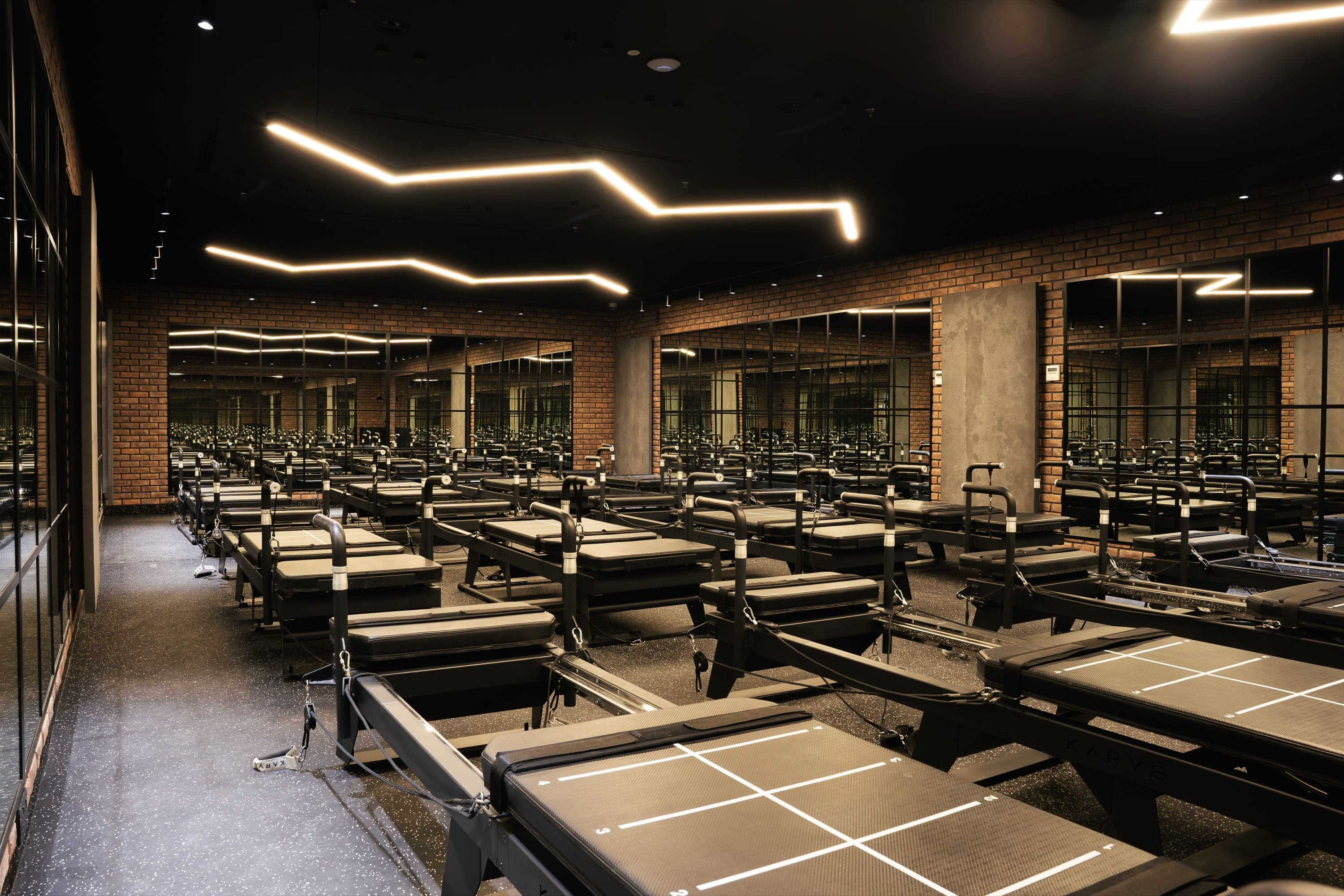
KARVE’s site guidance and architectural design system shape the unit into a KARVE club: the main Transformer studio, with the café, private sessions, retail and recovery features alongside.
Team and launch marketing
Instructors are trained and certified in the Transformer method while TONE, KARVE’s in-house agency, builds local awareness ahead of opening.
Opening day
KARVE-supplied Transformer machines are installed and the first class runs in the same format as the London clubs.
This is an illustration of the sequence, not a forecast. It carries no dates, costs or performance figures; commercial terms are shared with qualified applicants only.
Frequently asked questions
How much does a Pilates franchise owner make?
There is no single answer: it depends on the studio’s capacity, occupancy, pricing, rent and staff costs, and on how long it has traded. KARVE does not publish earnings figures. Ask any franchisor for its model in writing and have your accountant test it.
What matters most for a Pilates studio’s profit?
Occupancy and rent. Most costs are fixed, so the share of places filled decides whether a studio covers them. Rent is usually the largest fixed cost, which is why location and site size matter so much.
How long does a Pilates franchise take to break even?
It depends on pre-sales, how fast the timetable fills, rent and staffing. Ask each franchisor what ramp-up its model assumes and how many studios that assumption is based on. KARVE shares its unit economics under NDA.
Read next
The opportunity, explained
The franchise
Own something others can’t
The method, the club, the clientele, support, investment and your path to opening day.
Read the full page →Guide
Pilates franchise UK
What a KARVE franchise in the UK actually involves, and which cities are open.
Read →Guide
What a Pilates franchise costs
How to budget: the £500,000 liquid-capital threshold and what the investment covers.
Read →Guide
How to buy a Pilates franchise
The process from first conversation to opening day, step by step.
Read →Guide
Reformer Pilates franchise
Why Transformer Pilates™ and the KARVE club format are different.
Read →Guide
How to evaluate a Pilates franchise
Investment, support and growth: what to check, and how KARVE answers each one.
Read →Guide
Questions to ask before investing
Eighteen questions for any boutique fitness franchisor, and what a good answer sounds like.
Read →Guide
What makes a boutique fitness franchise work
The eight things that decide whether a boutique franchise works in the UK.
Read →Guide
Pilates franchise fees
The franchise fee, royalty and marketing levy, and what KARVE charges.
Read →Guide
Studio space requirements
About 7 m² per machine, 12 to 18 machines, a 2.9 to 3 m ceiling.
Read →Guide
Financing a franchise in the UK
Own capital, bank lending, Start Up Loans and the Growth Guarantee Scheme.
Read →Guide
Multi-unit and master franchise
Single club, multi-unit, area developer and master territory.
Read →Guide
Pilates franchise in the Middle East
Where KARVE operates in the GCC, and the markets open to partners.
Read →Guide
Do you need fitness experience?
Operators, not passive investors, with instructors certified by KARVE.
Read →Guide
Fitness franchise UK
The main types of fitness franchise and how to choose between them.
Read →Open territories
Every open KARVE territory.
Each open market has its own opportunity page. Territory rights are agreed case by case. Country development rights and any exclusivity are available only through a separate development agreement, where applicable.
United Kingdom & Ireland
By country: United Kingdom · Ireland
Europe
By country: France · Italy · Spain · Netherlands · Switzerland · Portugal · Austria · Germany · Denmark · Sweden · Norway · Finland · Czech Republic · Croatia · Hungary · Slovenia · Malta

Got what it takes?
Is your city
still open?
Territory rights are agreed case by case. Tell us where, and we reply within 24 hours.
This information is not a franchise offer. A franchise offer can only be made through a Franchise Disclosure Document. KARVE franchises are not offered, and will not be sold, in any jurisdiction where the offering has not been registered or exempted, and until the required disclosure document has been delivered in accordance with applicable law. Residents of registration states including California, Hawaii, Illinois, Indiana, Maryland, Michigan, Minnesota, New York, North Dakota, Rhode Island, South Dakota, Virginia, Washington and Wisconsin: this advertisement is not an offering. NEW YORK: an offering can only be made by a prospectus filed first with the Department of Law of the State of New York. Outside the United States, KARVE franchises are offered only in accordance with the franchise disclosure and registration laws of each jurisdiction. No agreement is signed and no payment is taken before any required disclosure period has passed. KARVE franchises are granted by KARVE Partners Ltd under licence from Karve IP Ltd, the owner of the KARVE and Transformer Pilates™ trademarks.